


If you’ve ever Googled “how to buy a Forbes article,” you’re not alone – and you’re not shady for asking. It’s one of the most common questions founders have when they start thinking about PR. The problem is that the answer most people find online is either misleading, outdated, or designed to sell you something that doesn’t actually exist. If you’re still weighing whether Forbes coverage makes sense at all, start with our breakdown of whether a Forbes feature is worth it in 2026.
I’m Simon, and my team at getonforbes.com has helped dozens of founders and companies get featured on Forbes – the real Forbes.com, not some franchise workaround. Let me walk you through what’s actually legitimate, what’s a waste of money, and how to protect yourself in 2026.
Can You Buy a Forbes Article? The Short Answer
No, you cannot buy a Forbes article the way you’d buy a banner ad or a sponsored post. Forbes editorial coverage is not for sale. There is no price list, no checkout page, and no backdoor.
What you can do is hire a PR professional or agency to pitch your story to Forbes contributors and reporters. If your story is genuinely newsworthy and you’re a credible source, there’s a real path to getting published. But that’s earned media – not purchased media.
The distinction matters. Anyone who tells you they can 100% guarantee a Forbes article for a flat fee – without even reviewing your company – is most likely either lying or delivering something very different from what you’re imagining.
What Buying a Forbes article Really Means in 2026
When people say they want to buy a Forbes article, they usually mean one of three things:
1. Can I pay someone to get me into Forbes? – Yes, in the sense that you can hire PR help. No, in the sense that you’re buying the article itself.
2. Can I pay Forbes directly for coverage? – No. Forbes has paid contributor content and sponsored content (clearly labelled), but organic editorial features are not purchasable.
3. Is there a guaranteed service? – Legitimate providers offer performance-based models, but “guaranteed placement” with money upfront and no vetting is a red flag.
Here’s what’s changed: in 2026, Forbes has tightened its editorial standards significantly. Reporters have told us directly that companies are vetted more thoroughly than ever before. The days of anyone with a chequebook getting a write-up are long gone – if they ever existed at all.
Startups and newer companies can absolutely still get featured on Forbes. But fishy businesses, companies with ongoing lawsuits, or founders with an unprofessional web presence? Very unlikely.
How Forbes Coverage Actually Works
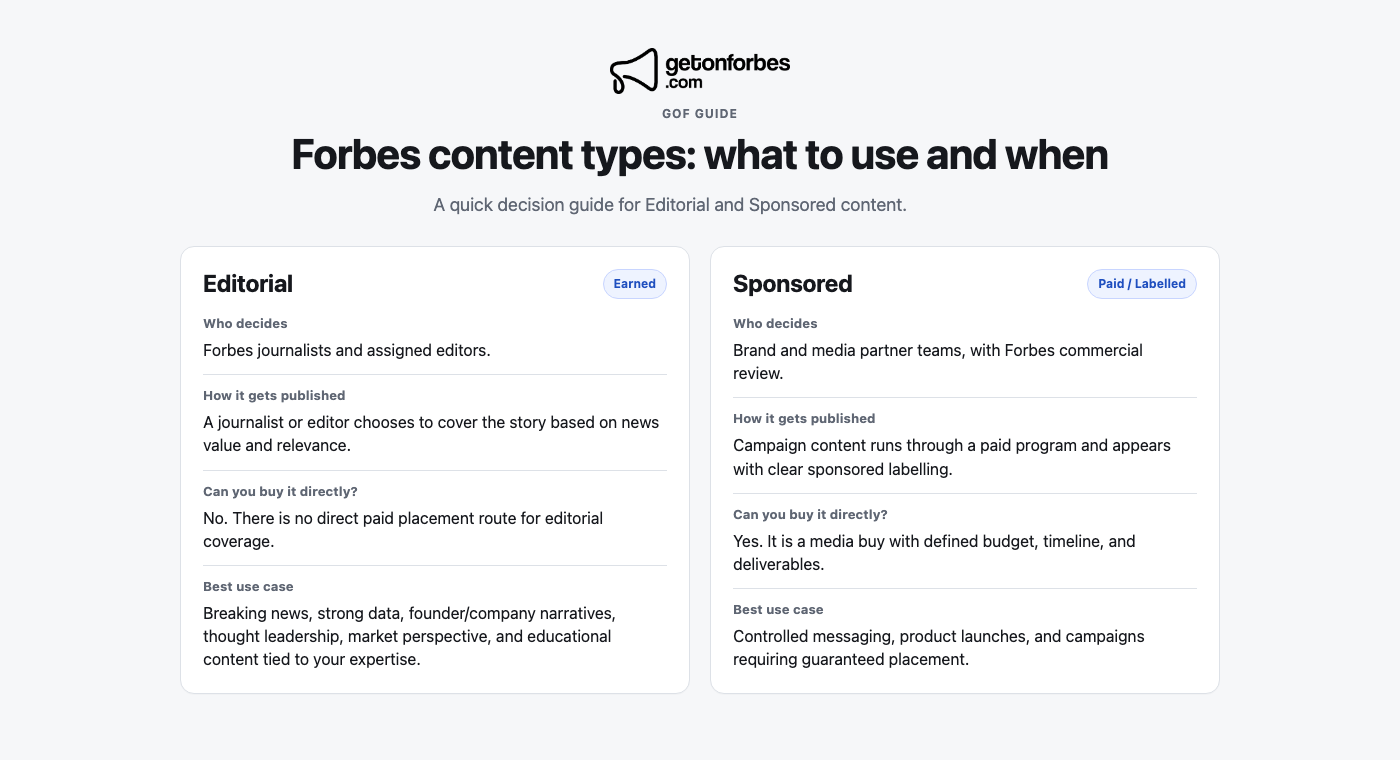
Forbes operates with a mix of staff reporters, editorial contributors, and paid content channels. Here’s the breakdown:
A lot of confusion comes from the fact that these channels sit under one recognizable brand name, but they serve very different purposes. When a founder says they want to get featured on Forbes, they usually mean earned editorial credibility. That is very different from simply appearing on a paid placement.
The practical takeaway is simple – before you hire anyone, ask them to explain exactly which route they are targeting for you. If they cannot explain the route in plain language, they probably do not control the process.
Staff reporters and editors cover beats – tech, finance, leadership, etc. They choose their own stories based on newsworthiness. Contributors are vetted experts who write regularly for Forbes. They have editorial freedom but must meet Forbes’ standards. Sponsored/paid content is clearly labelled as such – it’s advertising, not editorial. And it’s often shockingly expensive.
When we help clients get featured on Forbes, we’re pitching real reporters and contributors with real story angles. There’s no “pay-to-publish” arrangement. The journalist decides whether the story is worth covering.
What You Can Legitimately Pay For
Let’s be clear about what’s above board:
This is where many founders make expensive mistakes. Paying for expert execution is normal. Paying for fake certainty is not. The provider should be able to show you what work they will do before, during, and after outreach – not just pitch you a result.
In strong engagements, there is also editorial discipline behind the scenes. Good teams pressure-test your angle, remove weak claims, and shape your narrative so it can survive journalist scrutiny. That part is invisible to most clients, but it is often what determines whether the story lands.
Here are three things that every good PR agency will do:
1. Craft your narrative, identify the right journalists, and pitch your story.
2. If necessary, coach you on how to handle interviews, provide good quotes, and present your story compellingly.
3. Help you identify the angle that makes your company relevant to a Forbes audience.
What you’re paying for is expertise, relationships, and process – not the article itself. A good PR partner increases your chances significantly, but the editorial decision always rests with the journalist.
Common Scams to Avoid When Trying to Get Featured on Forbes
This is where it gets ugly. We’ve seen it all, and I want to save you from the worst of it.
The reason these scams keep working is emotional pressure. Founders want speed. Teams want a quick credibility boost. Scam operators understand that and build offers around urgency, ambiguity, and social proof that looks real at first glance.
In 2026, this is no longer just about overpriced services. It is also about identity deception. Some operations can look polished enough to pass a superficial check. That is exactly why hard verification steps are now mandatory, not optional.
For example, there’s the franchise bait-and-switch. Agencies take thousands upfront, promise “Forbes coverage,” and then deliver a link to Forbes India, Forbes Monaco, Forbes Liechtenstein, or some other international franchise. These are not Forbes.com. The audience, authority, and SEO value are completely different. If someone is vague about which Forbes, walk away.
Then there’s the AI-agency ghost operation. One of our clients came to us after waiting eight months with another provider. Think months upon months of excuses – “the editor is reviewing it,” “we’re in final stages,” the usual runaround – and which, by the way, can be valid excuses in organic PR, though not for such a long time. When they dug deeper, they discovered they’d been communicating with an AI assistant the entire time. The company’s identity and communication channels were fabricated. No real humans were ever involved, except for the person pocketing the money.
That’s not an edge case anymore. It’s happening regularly.
My advice: Work with established providers who have a verified track record. And if you’re doing outreach yourself, avoid the most common pitching mistakes. Get on a Zoom call. Talk to real humans. Ask for examples of recent placements – on Forbes.com specifically.
In some cases, we even had clients ask for 1-2 references among our past customers – a serious provider won’t have any issues to link you up with satisfied clients.
Forbes.com vs Forbes Franchises – What’s the Difference?
This catches more people than you’d think.
I am not saying every franchise publication has zero value. In some regional strategies, they can be useful. The problem is misrepresentation – when a buyer is sold one thing and delivered another.
If your commercial objective is authority with a global or US-heavy business audience, you need to evaluate channel fit honestly. A franchise link might look similar in a screenshot, but the market impact can be completely different in real sales conversations.
Forbes.com is the main US-based publication – the one with massive domain authority, millions of monthly readers, and the credibility that actually moves the needle for your brand.
Forbes franchises (Forbes India, Forbes Africa, Forbes Middle East, etc.) are licensed regional publications. They carry the Forbes name but operate independently. They have different editorial teams, different audiences, and – critically – different SEO value.
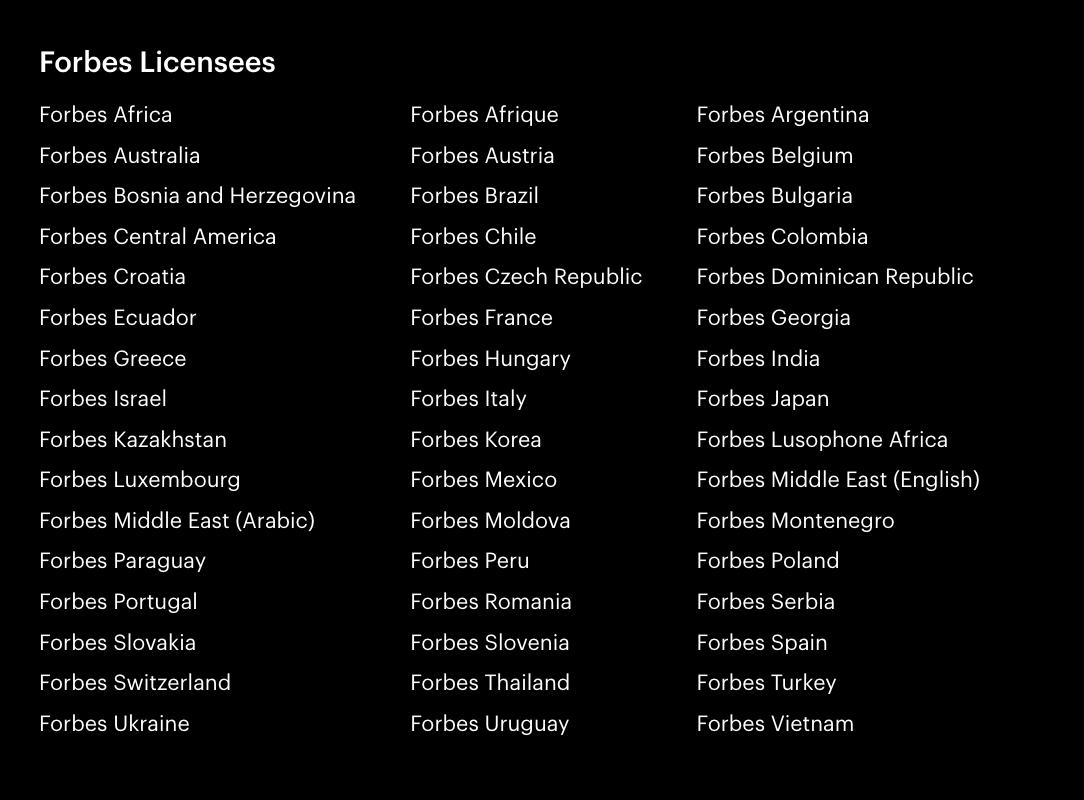
Getting published on a Forbes franchise is not the same as getting published on Forbes.com. It’s not worthless, but it’s not what most people are paying for when they hire a PR agency to “get them on Forbes.”
A major red flag: any provider who sells international Forbes franchises as a substitute for Forbes.com without making the distinction crystal clear. If they blur the line, they’re counting on you not knowing the difference.
Our 2-Stage Vetting Process Before We Accept Clients
We don’t take every client who comes to us. That’s not false modesty – it’s how we maintain our track record and our relationships with journalists.
Most providers sell first and evaluate later. We do the opposite. The reason is simple – bad-fit campaigns waste everyone’s time and can burn trust with reporters who expect relevance.
This is also why we can offer a performance-based model after vetting. We only move forward when we believe there is a credible path to publication, not just a theoretical possibility on paper.
Stage 1: Theoretical fit
We evaluate whether your company, your story, and your industry are a realistic match for Forbes coverage. We look at your web presence, past PR, the seriousness of your business, and relevance to a Forbes audience. Hard-no industries – adult entertainment, gambling, anything legally grey – get filtered out here. So do businesses that look unpolished or unverifiable.
Stage 2: Practical fit
If Stage 1 looks good, we move to actual reporter-level evaluation. Can we find a specific journalist within our established relationships who covers your space? Is there a concrete angle that works for their beat? This is where theory meets reality.
If we can’t see a credible path to publication after both stages, we tell you. We’d rather turn down a fee than damage our reputation – or yours.
What Makes a Story Pitchable to Forbes Contributors
Good news: Forbes covers an enormous range of topics. If you’re running a solid company and you’re a credible founder, there’s usually an angle. The question is what angle.
One thing I always tell founders – your story is rarely “not interesting.” More often, it is just framed the wrong way. A weak framing sounds like self-promotion. A strong framing sounds like insight with relevance for a broader audience.
That reframing step is where most of the strategic value sits. The goal is not to exaggerate your company. The goal is to connect what you know to what Forbes readers actually care about right now.
Stories that tend to work:
1. First-hand experience with broad relevance – You solved a problem that thousands of other founders face? That’s a story.
2. Original data or insights – You have numbers nobody else has? Journalists love that.
3. Genuine innovation – Not “we’re disrupting X” hopium, but actual novel approaches to real problems.
4. Broad audience benefit – If the Forbes reader walks away having learned something useful, you’re in good shape.
Stories that don’t work: pure self-promotion, vague thought leadership with no substance, or anything that reads like a press release rather than a story. For specifics on structure and tone, see our guide on how to write a Forbes pitch.
Pricing and Timelines – What to Expect in 2026
Let’s talk numbers honestly.
Pricing conversations are where many buyers either overpay or under-evaluate risk. A low price with no process can be more expensive than a higher price with real execution and accountability.
What matters most is not the number itself – it is the model behind it. Who is doing the work, how is quality controlled, what happens if timelines slip, and what protection do you have if publication does not happen?
Pricing: Most legitimate PR services for Forbes-level placements range from $2,500 to $10,000, depending on your industry, the scope of the engagement, and the quality of the final placement. At our firm, after completing the two-stage vetting process, we work on a performance basis – if we don’t get you published, we don’t charge.
You’ll find providers charging $15,000 to $25,000 or more. Sometimes that’s justified by a broader PR strategy. Often, though, it reflects multiple layers of outsourcing – you’re paying for middlemen, not results. More layers mean more risk and less accountability.
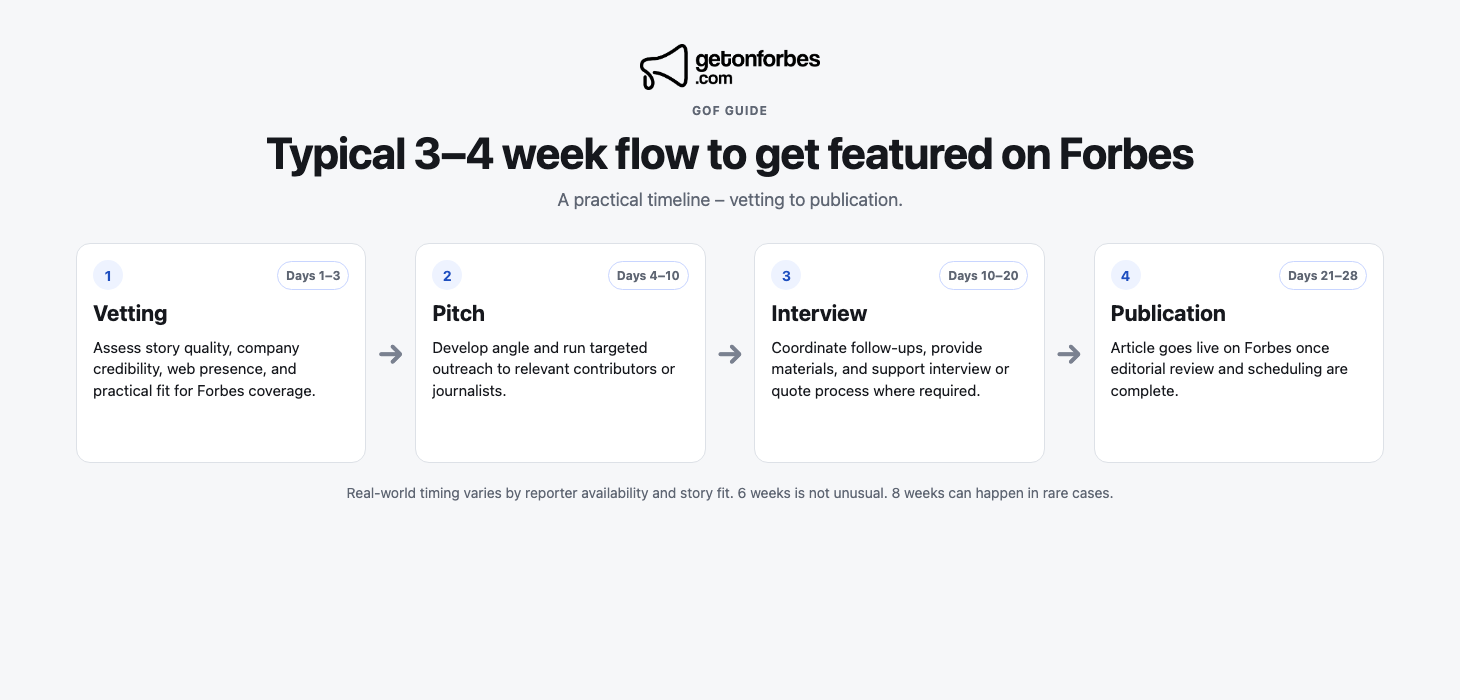
Timelines: A typical engagement runs 3 to 4 weeks from pitch to publication. Six weeks is not unusual. Up to eight weeks happens but is rare. Anything beyond that? Start asking hard questions. If you’re at the eight-month mark with nothing to show – like the client I mentioned earlier – something may be seriously wrong.
How to Evaluate a PR Provider – Green Flags and Red Flags
If you only remember one part of this guide, make it this section. Provider quality is the single biggest variable in whether this process helps your business or hurts it.
Green flags
They vet you before taking your money. A provider who accepts everyone is not selective enough to maintain journalist relationships. They’re honest about impact. A Forbes article alone does not guarantee fame or revenue. Anyone who says otherwise is selling you a fantasy. You need an amplification strategy around the placement.
Also, they specify Forbes.com explicitly – not “Forbes” in vague terms. They offer a video call with a real human. You can verify their identity and track record. They have verifiable past placements you can check yourself.
Red flags
Guaranteed placement with a large upfront payment and no vetting. Vagueness about which Forbes property they’re targeting. Selling Forbes franchise placements as equivalent to Forbes.com. No verifiable team, no video calls, no real portfolio. Timelines that stretch endlessly with recycled excuses.
Due Diligence Checklist Before You Hire Anyone
Before you sign anything or send any payment, run through this:
Treat this checklist like a pre-investment audit. If a provider pushes you to skip checks because “speed matters,” that is usually a sign they do not want scrutiny.
In serious PR buying, clarity protects both sides. The best providers should welcome detailed questions because strong process is part of what you are paying for.
✅ Verify the provider’s identity – real website, real team bios, real LinkedIn profiles, and a video call.
✅ Ask for specific Forbes.com examples – not screenshots, but live links you can verify.
✅ Clarify which Forbes property is included – Forbes.com or a franchise.
✅ Understand the payment model – upfront, performance-based, and what happens if they don’t deliver.
✅ Ask about their vetting process – if they don’t evaluate fit, that’s a problem.
✅ Check for outsourcing layers – know who is actually doing outreach.
✅ Get realistic timeline expectations in writing – ideally in contract form.
FAQ: Buying Forbes Articles, Pricing, and Risk
How much does it cost to get featured on Forbes?
Legitimate PR services typically charge between $2,500 and $10,000 for Forbes-level placements. Beware of providers charging $15,000–$25,000 with no performance guarantee – that often signals outsourced layers and inflated margins.
Can you guarantee a Forbes article?
No ethical provider 100% guarantees editorial placement, because the final decision rests with the journalist. What a good provider can offer is a performance-based model – if the article doesn’t get published, you don’t pay.
How long does it take to get published on Forbes?
Typically 3–4 weeks. Six weeks is common. Beyond 8 weeks with no clear progress, something is likely wrong.
Is buying a Forbes article illegal?
Paying for PR services is completely legal and standard. What would be problematic is paying a journalist directly for coverage – that’s not what legitimate PR firms do. They pitch stories; journalists decide independently.
What’s the difference between Forbes.com and Forbes India / Forbes Africa?
Forbes.com is the main US publication with global authority. Regional franchises are separate operations with different teams, audiences, and SEO value. Make sure you know which one you’re getting.
Can startups get featured on Forbes in 2026?
Absolutely – if the business is legitimate, the story is compelling, and the founder is credible. Forbes’ vetting standards have increased, but the door is open for companies that meet the bar.
Ready to Get Featured on Forbes – the Right Way?
If you’ve read this far, you’re already ahead of most founders who get burned by shady PR offers. You know the difference between earned media and a scam, and you know what questions to ask. For the full DIY process, check our step-by-step guide on getting featured on Forbes.
Here’s what working with us looks like: we start with our two-stage vetting process. If your company is a fit, we move forward on a performance basis – you only pay if you get published on Forbes.com. No bait-and-switch with franchise links. No AI assistants pretending to be your account manager. Real humans, real journalist relationships, real results.
We’ll tell you honestly whether Forbes coverage is realistic for your business – and if it’s not, we’ll tell you that too.