


Is a Forbes article even worth it in 2026? This question comes up in nearly every initial call we take.
And to be fair, it’s not a stupid question. The media landscape has shifted, criticism about Forbes and other high-profile media has surfaced (we cover what’s legit and what isn’t when buying Forbes coverage in a separate guide), and the way people discover and trust information is fundamentally different from even two years ago.
That said, while these points have certainly affected the impact of organic Forbes articles, even more recent shifts in consumer and organizational behavior are now turning everything upside down again – and data shows it’s for the better.
But even if the general outlook is very positive, an honest answer also needs to include that it entirely depends on who you are, what you’re trying to achieve, and whether you’re willing to do the work after publication.
We’ve turned down clients because the fit wasn’t there. A local car garage once approached us, genuinely believing a Forbes feature would transform their business. It wouldn’t have.
But thankfully, we’re also being approached by super innovative companies, hungry founders, and organizations with genuinely interesting stories – all examples of businesses that can benefit tremendously from a Forbes feature now and in the coming years.
It’s time to get into the nitty-gritty. Let’s break down what actually matters in 2026.
What has changed for Forbes in 2026?
Forbes is one of those media that seems to be constantly reinventing itself. What was once a highly specialized business magazine has turned into a platform covering virtually every topic, with dozens of international franchises, thousands of content pieces every day, and various categories and content types.
Forbes has gotten somewhat of a bad rap over the last few years. Some of it is justified, other things are unnecessarily blown up. For example, it’s true that the company’s contributor program saw a lot of low-skilled writers onboarded who couldn’t really produce high-quality articles. Some writers literally made us angry while reading their articles.
However, it’s definitely not true that all Forbes contributors are bad or engaging in unethical behavior – in fact, the vast majority that we worked with absolutely try to keep up with editorial standards.
Then there’s the 30 Under 30 franchise, which went from originally being an authoritative list of 30 highly interesting individuals to hundreds upon hundreds of people selected for a number of categories and geographies, diluting the value and meaning of being featured in such a list.

That said, we’ve heard firsthand that Forbes is currently working on improving the content on the site – by kicking out bad writers and by demanding higher quality content, research, and standards from their writers. While this is bad news for dubious companies, it’s undoubtedly great news for serious organizations.
The perceived quality and reputation of Forbes is starting to improve again, and let’s be honest, the average media consumer probably didn’t even realize these things were wrong to begin with.
Additionally, organic and high-authority PR is experiencing a surge in importance again, now that users are increasingly relying on AI recommendations. AI tools are actively relying on top-tier media coverage to dish out these recommendations, even if the articles don’t include any links.
Because of these reasons, we believe, in fact, the actual value of a Forbes feature has increased significantly in 2026.
Which goals can I achieve by getting published on Forbes?
Not every business objective is equally well-served by a Forbes placement, and understanding these distinctions upfront is more valuable than any sales pitch. Here are the four most common goals most of our clients are looking to achieve with a Forbes feature paired with our thoughts on how realistic they are.
1. Building trust
Building trust and authority is the strongest use case by a wide margin. If your business operates in a trust-sensitive industry – finance, health tech, cybersecurity, enterprise software – a Forbes feature functions as third-party validation that’s difficult to replicate through owned channels alone.
Decision-makers, investors, and partners notice when a company has been featured in Forbes, and it changes the texture of conversations in ways that are hard to quantify but easy to feel.
2. Generating leads & sales
Lead generation is where expectations need the most careful management. Some clients see meaningful inbound enquiries after a Forbes feature goes live, while others see almost nothing. The difference usually comes down to amplification – what you do with the piece after publication.
A Forbes article sitting passively on the internet is an authority asset. If you want to understand the full process, our guide on how to get featured on Forbes covers it step by step. Turning it into a lead generation tool requires deliberate distribution through paid channels, retargeting campaigns, and integration into your sales process. Expecting the article alone to drive leads without an amplification strategy is one of the most common mistakes we see.
3. Raising funds
Fundraising support can be significant when executed strategically. The right feature, in the right Forbes category, covering the right topic, can meaningfully support a funding round. Investors do their homework, and a substantive Forbes piece in their research trail carries weight. That said, it works best as part of a broader media and communications strategy rather than as a standalone tactic.
4. Personal branding
Personal brand building has actually gotten stronger as a use case in 2026. AI-powered background checks, investor due diligence tools, and automated reputation scans all pull from authoritative media .
Having your name associated with substantive Forbes coverage creates a persistent signal that surfaces across these systems for years after publication. This works best when combined with your own channels – a strong LinkedIn presence, a newsletter, speaking engagements – rather than treated as a substitute for them.
When is it worth it – and for whom?
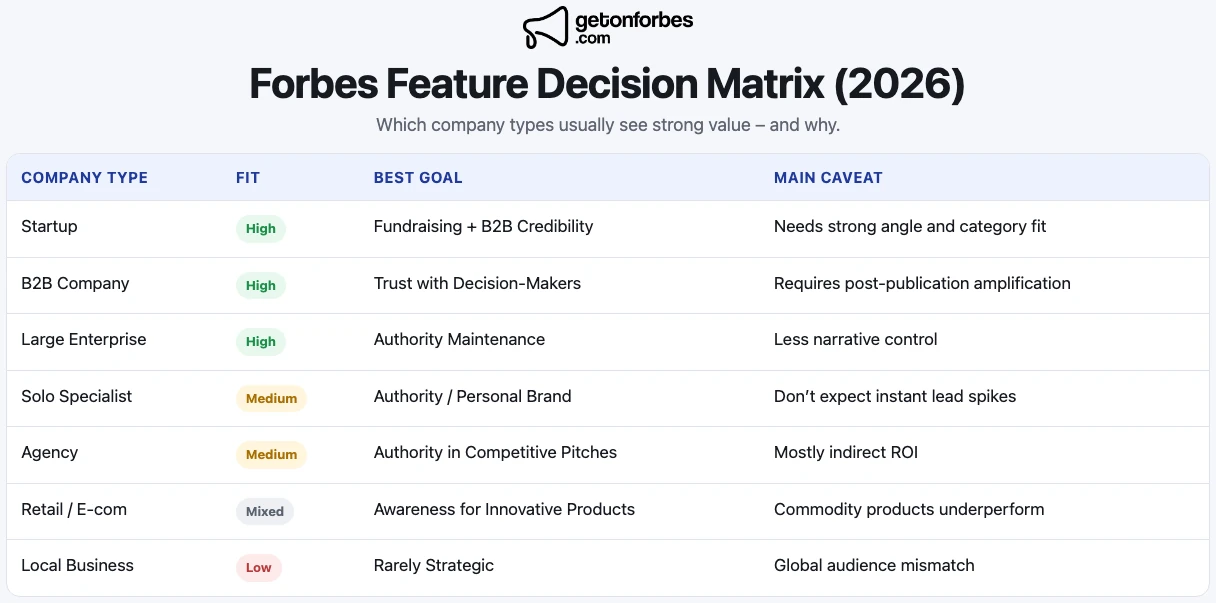
The value of a Forbes feature varies dramatically by organisation type, and pretending otherwise does everyone a disservice. If you’re wondering whether getting featured on Forbes is worth it for your business, here’s an honest breakdown by company profile.
Solo specialists and consultants
Freelancers, solo entrepreneurs, coaches, lawyers, consultants, and other professionals can find Forbes excellent for thought leadership and credibility. If you’re a cybersecurity consultant trying to land enterprise clients, or a financial advisor building authority in a specific niche, a well-crafted Forbes feature signals legitimacy in ways that a personal blog simply cannot match.
Still, landing a large standalone feature as a solo operator is harder; often even impossible. If you’re expecting massive lead generation from a single piece, you’re setting yourself up for disappointment. The value is cumulative and reputational rather than transactional.
Startups
Small innovative businesses still represent one of the strongest fits, particularly for companies in AI, Web3, enterprise technology, and other sectors where the Forbes audience overlaps heavily with potential customers, partners, and investors.
A well-placed feature can support B2B sales conversations and fundraising simultaneously. The key point is “well-placed.” A feature that positions the startup within a broader trend, demonstrates real traction, or offers genuine insight into a problem space is where the value lives. Unlike with solo entrepreneurs, a small feature will usually not bring you any significant benefits.
Agencies
Agencies should aim to derive their primary value from authority rather than direct leads. To keep it real: you’re not going to generate a flood of inbound enquiries from a Forbes piece, but you will create a credibility asset that strengthens every pitch deck, every proposal, and every “about us” page. In competitive agency pitches, these third-party validation signals matter considerably, even if the value is indirect.
Retail and e-commerce brands
Innovative products, compelling origin stories, or brands that tap into cultural trends can benefit from Forbes coverage – we’ve seen cases where the right product feature drove over 100,000 clicks through social sharing alone. Boring products or e-commerce shops that resell other brands are a harder sell, however, because there’s usually not much newsworthy about them.
Local businesses
If you own a local business, then you should probably look into investing your PR budget elsewhere. Forbes reaches a global audience; the idea is to talk about big things, not local landscaping businesses.
We’ve declined many local businesses for this reason – not because they aren’t good businesses, but because the platform doesn’t match the market. Exceptions exist for brands that attract visitors from outside their area, such as top-tier hotels, Michelin restaurants, events such as conferences or concerts, or local companies with stories that genuinely transcend geography.
B2B companies
B2B enterprises are broadly a strong fit because Forbes readers include the decision-makers, procurement leads, and executives that most B2B organisations are trying to reach.
In fact, research from 6sense indicates that B2B buyers do extensive online research before ever contacting a vendor, and being present in the publications those buyers read during their research phase is strategically valuable.
The key is matching your Forbes strategy to your actual sales motion – a feature about your company’s approach to a specific industry problem is far more useful than a generic corporate profile.
Large enterprises
Companies with thousands of employees and well-known brands typically find it easier to secure Forbes coverage, since the editorial bar for newsworthiness is lower when you have scale, revenue, and recognisable leadership.
The trade-off is less narrative control; you’re more likely to be covered as part of a broader industry story. Oftentimes, ultra-large clients expected that we could control the article content to a T and were surprised when we told them the reporters actually decide for themselves what to write.
The value for enterprises tends to be in ongoing authority maintenance and providing content that sales and marketing teams can leverage across channels.
What realistic outcomes look like
The primary outcome of a Forbes feature is an authority boost – a measurable shift in how your company is perceived by the people who matter to your business. That’s not a flashy metric, but it’s a durable one that compounds over time.
Beyond authority, we’ve observed a range of secondary outcomes with some regularity.
Cascading PR pickups, where other outlets cover you because Forbes did, happen more often than most clients expect.
Partner and investor outreach triggered by a feature is common, particularly for startups.
Occasional social virality is possible but inherently unpredictable.
What we don’t see regularly is an instant spike in leads directly attributable to the article. It happens, but building your entire strategy around that expectation is a mistake.
Why some features underperform
When a Forbes feature doesn’t deliver the expected results, the cause is almost always one of a few recurring patterns.
1. The company went in without a clear objective, wanting “a Forbes article” rather than a specific business outcome.
2. They had no amplification plan, so the article was published, and they shared it once on LinkedIn before moving on. Post-publication activation was poor, meaning they never integrated the feature into their sales materials, email sequences, or investor communications.
3. External timing worked against them, and a major news event buried the piece on publication day.
Short-term disruptions and black swan events are uncontrollable. Everything else is entirely within your power to get right. The companies that extract the most value from Forbes coverage are those that treat publication day as the starting line rather than the finish line. For more on what goes wrong during outreach, see our breakdown of common pitching mistakes.
That means having distribution channels ready, sales collateral updated, and a clear plan for how the article fits into your broader marketing and communications strategy.
What is the ROI of a Forbes article?
Evaluating the return on a Forbes feature requires looking beyond direct attribution, because the value often shows up in places traditional analytics don’t capture well.
Track changes in your website’s conversion rate in the weeks following publication – even a small uptick, compounded over months of the article remaining live, can represent significant value.
Monitor your presence in AI recommendation engines and how those systems describe your company before and after publication. Ask new customers and partners whether the article influenced their decision to engage; the qualitative answers are often more revealing than any dashboard metric.
Before pursuing a Forbes feature, honestly assess whether you have a clear and specific objective beyond “getting featured,” a plan for amplifying the piece after publication, realistic expectations about direct lead generation, and budget and bandwidth for post-publication activation.
If you’re missing more than one of these, the investment is likely premature. When you are ready, writing a strong pitch is the first practical step.
Why authority PR matters more in the AI recommendation era
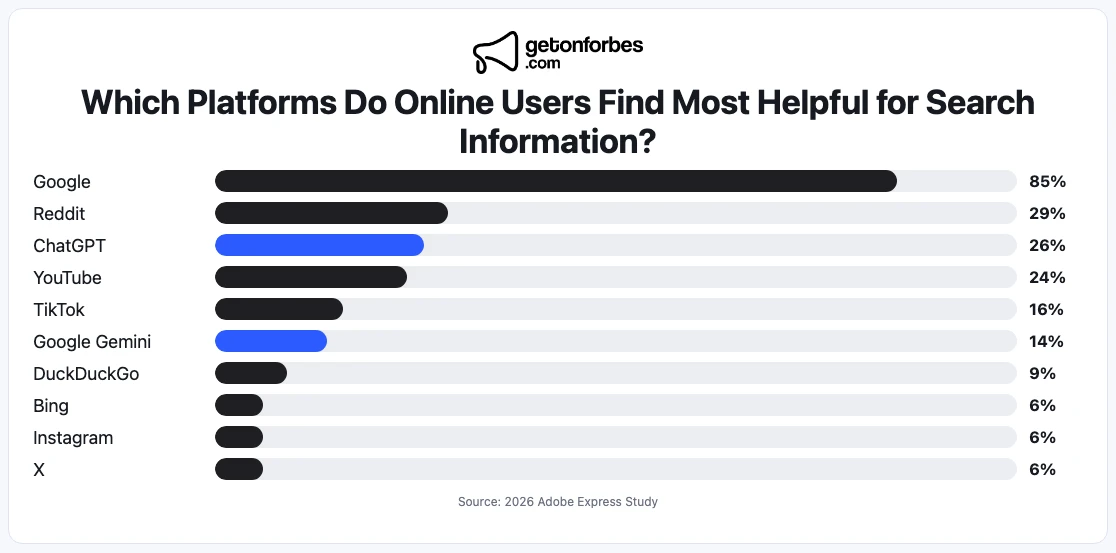
The way people evaluate businesses is changing faster than most marketing strategies can keep up with, and this shift is redefining what makes PR valuable in 2026.
A recent study by Adobe highlights that both consumers and small business owners increasingly use ChatGPT, Gemini, and other Large Language models when searching for information.
Moreover, Google’s AI Overviews now appear across a growing share of search queries. Research from Pew shows that users are less likely to click through to individual links when an AI summary appears in results.
The practical implication is significant: being mentioned in authoritative sources now matters even when nobody clicks the link, because AI systems pull from those sources to construct the recommendations and summaries that users actually read.
We observed this directly with a client who ranked well in traditional Google search but was entirely absent from AI-based recommendations.
After a campaign that included a substantial Forbes feature alongside coverage in smaller, relevant outlets, the client moved into the top three recommendations across multiple AI tools. That’s an observational outcome rather than a guaranteed one, but it illustrates a pattern we’re seeing repeatedly across different industries and company sizes.
Forbes remains one of the highest-authority domains on the internet, with monthly traffic and domain credibility that few publications can match. In an era where AI systems weigh source authority heavily when deciding what to recommend, that positioning matters more than it did when clicks were the only currency.
FAQs
Does a Forbes feature help with SEO?
Search engines like Google consider high-authority PR features when ranking company websites. In fact, Google started boosting the effects of no-follow backlinks in 2019, provided that a backlink comes from a reputable source. That said, the effects should not be overestimated; it is certainly not sufficient to replace a real SEO strategy.
Does a Forbes feature guarantee that AI will recommend my business?
We have seen stronger AI visibility after high-authority PR campaigns, but this does not mean it is guaranteed. It depends on the scope of an article, the context and prominence of the business feature, and other factors.
When is a Forbes feature not worth it?
If you do not have a clear and realistic objective, if your audience is not on Forbes, and if you do not have a plan to use your feature in marketing, then we advise skipping Forbes for now.
How to know if my company is ready for Forbes?
Check story quality, credibility signals, and your ability to activate the feature after publication. If you are unsure, schedule a free consultation with our team to discuss whether a feature makes sense for you.
The bottom line
Forbes in 2026 is neither the universal golden ticket some agencies sell it as, nor the diminished platform that cynics claim. It’s a powerful tool with specific strengths – authority building, AI-era visibility, decision-maker reach – that works exceptionally well for certain companies and poorly for others.
The companies that get the most value are the ones that go in with clear objectives, choose the right angle, and treat publication as the beginning of the work rather than the end. If that describes your approach, a Forbes feature is very likely worth it. If you’re hoping a single article will solve a marketing problem on its own, it won’t – regardless of where it’s published.